The full paper is available at SSRN (this version: 22 September 2026).
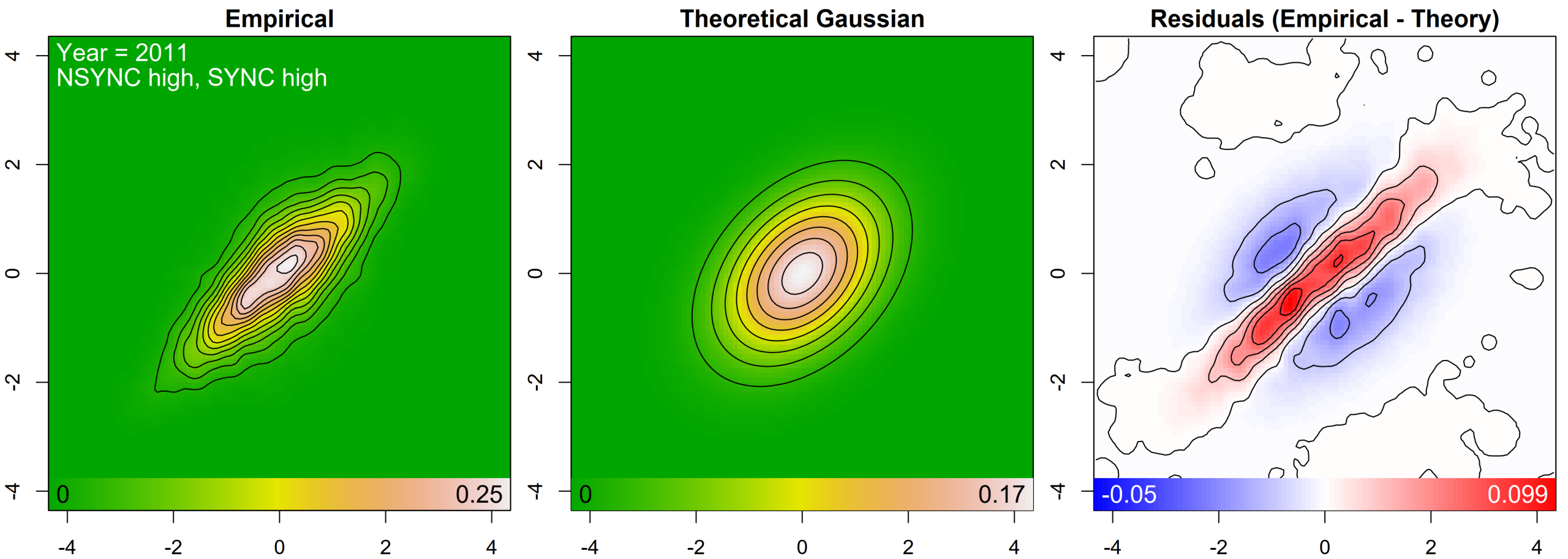
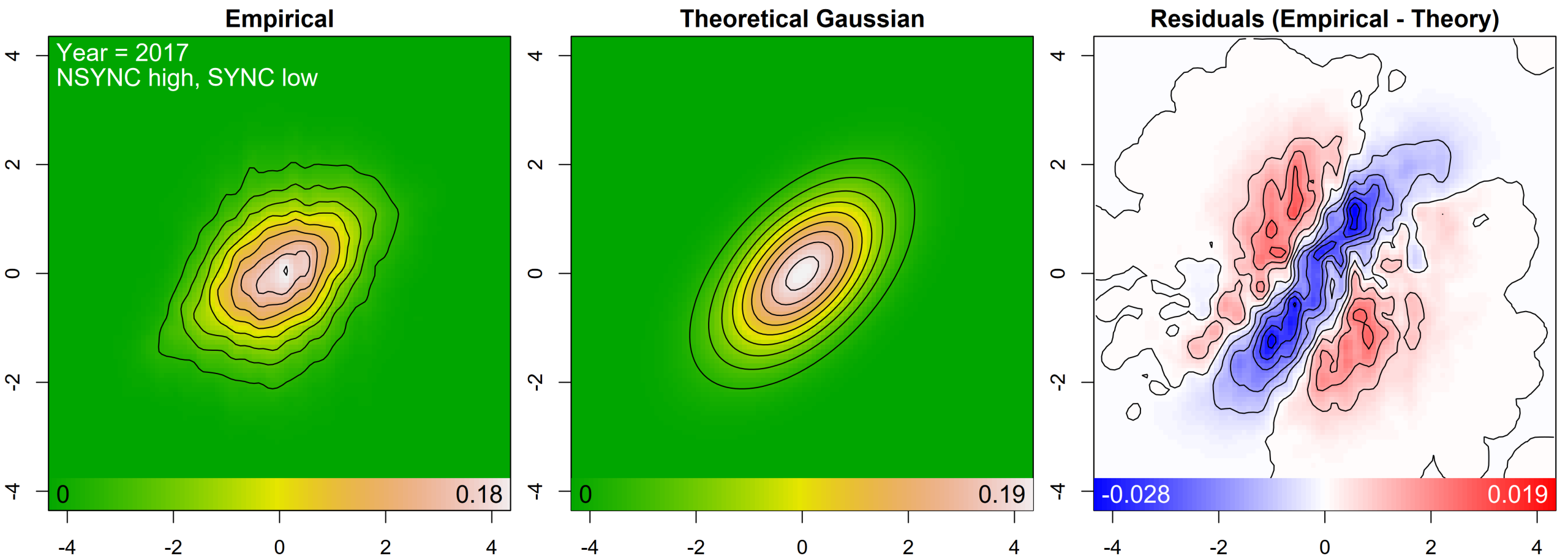
Traditional stock price synchronicity measures are based on the coefficient of determination (R-squared) from a linear market model and therefore capture only dependence explained by linear correlation. We develop a measure of non-Gaussian stock price synchronicity based on mutual information. It is defined as the difference between observed mutual information and the mutual information implied by a Gaussian dependence structure with the same correlation coefficient, and is related to the Kullback-Leibler divergence between the observed and Gaussian copulas. Using a sample of US firms, we show that stock-market dependence frequently exceeds that implied by linear correlation alone and exhibits substantial cross-sectional and time-series variation. Non-Gaussian synchronicity is positively associated with R&D activity and market-to-book ratios and negatively associated with asset tangibility, while traditional measures of downside vulnerability have little explanatory power. Conventional R-squared-based and rank-based synchronicity measures exhibit remarkably similar determinants, suggesting that they capture a common dependence-strength dimension, whereas non-Gaussian synchronicity is explained by a distinct set of firm characteristics. The evidence suggests that non-Gaussian synchronicity captures economically meaningful features of the dependence structure beyond its overall strength and that it primarily reflects common upside optionality rather than common downside vulnerability.